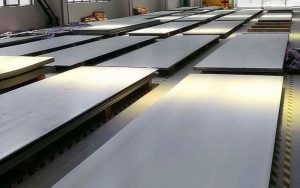
ASTM A572 steel plate is a high-strength low-alloy structural steel specified for load-bearing members in buildings, bridges and fabricated steel structures. Grade 50 provides a minimum yield strength of 345 MPa [50 ksi], while Grade 60 increases this to 415 MPa [60 ksi], allowing the required strength level to be matched to the structural design rather than treating all A572 grades as interchangeable.
A572 Grade 50 is specified for riveted, bolted or welded structures, while Grade 60 is used for riveted or bolted bridge construction and for riveted, bolted or welded structures in other applications. Grade selection is therefore controlled by required yield strength, plate thickness, connection method and project toughness requirements, particularly where welded structural components are subject to notch-toughness criteria.
Key Properties:
- Composition: ASTM A572 contains various alloying elements such as carbon, manganese, phosphorus, sulfur, and silicon. It is available in several grades, including Grade 42, 50, 55, 60, and 65, with varying yield and tensile strengths.
- Mechanical Properties:
- Yield Strength: Generally ranges from 290 MPa (42,000 psi) for Grade 42 to 450 MPa (65,000 psi) for Grade 65.
- Tensile Strength: Ranges from 420 MPa (60,000 psi) to 550 MPa (80,000 psi), depending on the specific grade.
Applications:
ASTM A572 steel plates are widely used in:
- Construction of bridges and buildings.
- Structural components in industrial and commercial construction.
- Fabrication of heavy equipment and machinery.
- Low-temperature applications due to its impact resistance.
- Grades 42, 50, 55 are intended for riveted, bolted or welded structurals, Grade 60 and 65 are for riveted and bolted construction of bridges, welded constructions and more applications.
Overall, ASTM A572 steel plates offer a combination of strength, durability, and versatility, making them suitable for a wide variety of structural applications.
Referenced Documents:
ASTM Standards:
- A6/A6M: General requirements for rolled structural steel bars, plates, shapes, and sheet piling
- A36/A36M: Carbon structural steel specification
- A514/A514M: Specification for quenched and tempered alloy steel plate with high yiled strength, suitable for welding
- A588/A588M Specification for High-Strength Low-Alloy Structural STeel, up to 50 ksi [245 MPa] Minimum Yield Point, with Atmospheric Corrosion Resistance
ASTM A572 Grade 50, 60 & 65 Data Sheet Properties
Chemical properties shall conform to the requirements prescribed in Table 2 and Table 3 for alloy elements. Tensile strength and yiled strength shall comply with Table 4.
Chemical Composition
Table 3:
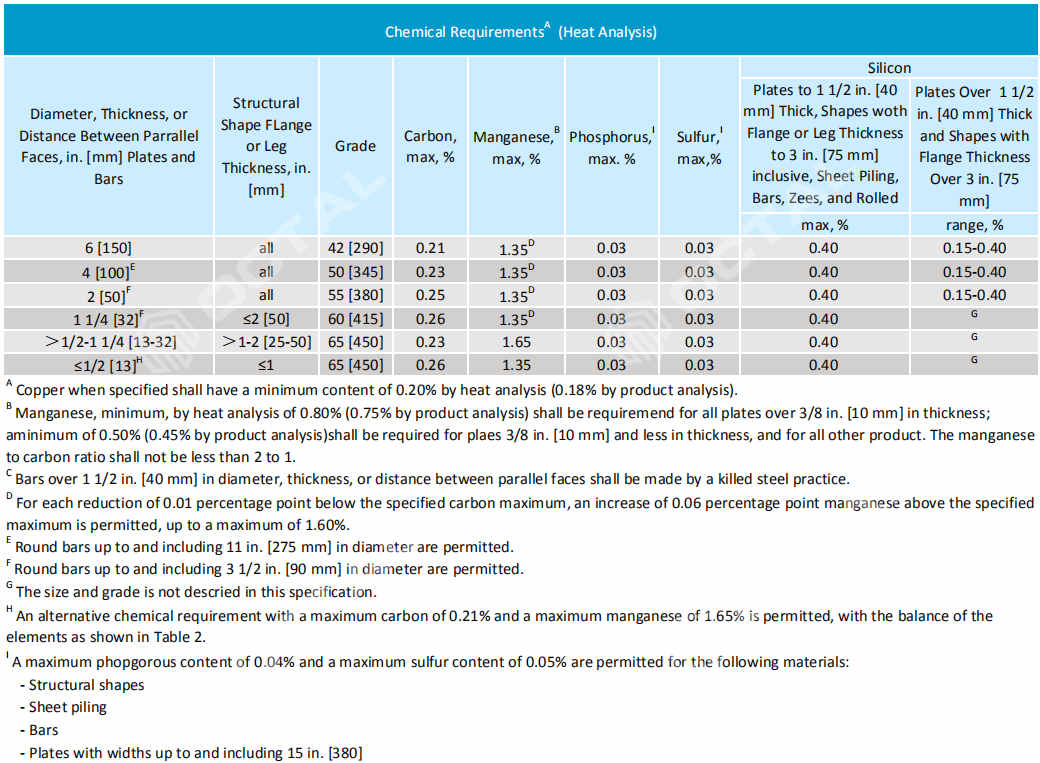
Table 3: Alloy elements composition
Type A | Elements | Heat Analysis, % |
|---|---|---|
1 | Columbium | 0.005-0.05B |
2 | Vanadium | 0.01-0.15C |
3 | Columbium | 0.005-0.05B |
Vandadium | 0.01-0.15C | |
Columbium plus vanadium | 0.02-0.15D | |
5 | Titanium | 0.006-0.04 |
Nitrogen | 0.003-0.015 | |
Vanadium | 0.06 max |
A: Alloy content shall comply with Type 1, 2, 3, or 5 and shall be on test report.
B: Product analysis limits = 0.004 to 0.06%.
C: Product analysis limits = 0.005 to 0.17%.
D: Product analysis limits = 0.01 to 0.16%.
Mechanical Properties
Grade | Yield Point, min | Tensile Strenth, min | Minimum Elongation, % B,C,D | |||
|---|---|---|---|---|---|---|
kis | [MPa] | ksi | [MPa] | in 8 in [200 mm] | in 2 in [200 mm] | |
42 [290] | 42 | [290] | 60 | [415] | 20 | 24 |
50 [345] | 50 | [345] | 65 | [450] | 18 | 21 |
55 [380] | 55 | [380] | 70 | [485] | 17 | 20 |
60 [415] | 60 | [415] | 75 | [520] | 16 | 18 |
65 [450] | 65 | [450] | 80 | [550] | 15 | 17 |
A: Specimen shall comply with Specification of A6/A6M.
B: Elongation not required to be determi ed for floor plate.
C: For wide flange shapesover 426 lb/ft [634 kg/m], elongation in 2 in. [50 mm] of 19% minimum applies.
D: For plates wider than 24 in. [600 mm], the elongation requirement is reduced two percedntage points for Grade 42, 50, and 55 [290,345,and 380], and three percentage points for Grade 60 and 65 [415 and 450]. See elongation requirement asjustments in the Tesion Tests section of Specification A6/A6M.
General Requirements for Delivery
Structural steel plates supplied under ASTM A572 must meet the requirements outlined in the current edition of Specification A6/A6M for the specific structural product ordered, unless there is a conflict, in which case this specification will take precedence.
Coils are not considered applicable to this specification until they are processed into a finished structural product. Structural steel plates produced from coils are those that have been cut to individual lengths from a coil. The processor is directly responsible for the operations involved in transforming a coil into a finished structural product. These operations include decoiling, leveling or straightening, hot-forming or cold-forming (if applicable), cutting to length, testing, inspection, conditioning, heat treatment (if applicable), packing, marking, loading for shipment, and certification.
Our Supply Range:
Description: Carbon Steel ASME SA572/ ASTM A572 Grade C & D
Manufacturing Types: Hot Rolled
Thickness: 2 to 150 mm
Width: 0.6m to 3m
Length: 6m, 12m, customized
Surface: Natural, Painted
Packing: Standard sea packing, bundled with streel strip.
FAQ
Q: What is the difference between ASTM A572 Grade 50 and Grade 60?
A: Grade 50 has a minimum yield strength of 345 MPa [50 ksi], while Grade 60 provides 415 MPa [60 ksi]. Grade 50 is intended for riveted, bolted or welded structures; Grade 60 has different bridge-use limitations, so selection depends on required strength and connection method.
Q: Is Charpy impact testing mandatory for ASTM A572 Grade 50 or Grade 60?
A: No. ASTM A572 does not impose one universal Charpy requirement for every application. Where notch toughness is important, such as welded bridge construction, the required toughness criteria must be agreed between the purchaser and producer and stated in the project requirements.
Q: Can ASTM A572 Grade 60 be welded?
A: Grade 60 may be used in welded structures outside the bridge-specific limitation when a welding procedure suitable for the grade and service is applied. For bridge construction, ASTM A572 identifies Grade 60 primarily for riveted or bolted construction, so welded use must be checked against the governing project and toughness requirements.
Q: Can ASTM A588 steel replace ASTM A572 Grade 50?
A: Not automatically. ASTM A572/A572M specifically states that ASTM A588/A588M cannot substitute for ASTM A572/A572M without agreement between the purchaser and supplier, even where the two materials appear suitable for similar structural applications.
Related Products:
ASTM A283 Grade C, D Plates
ASTM A516 Grade 70, 65, 60 Steel Plate
ASTM A515 Grade 60, 65, 70 Plate
ASTM A537 Class 1, 2 Plates
ASTM A572 Grade 50, 60 Steel Plates
AH36, DH36, EH36 Shipbuiding Steel Plates
Carbon Steel Plate