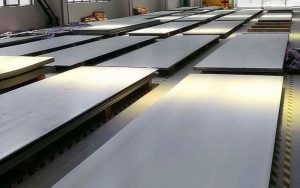
ASTM A537 steel plate is a heat-treated carbon-manganese-silicon steel specified for fusion-welded pressure vessels and structures. A537 Class 1 is supplied in the normalized condition, while A537 Class 2 is quenched and tempered, giving the two classes different strength levels for pressure-retaining fabrication.
For plates 65 mm [2.5 in.] and under, Class 1 has a minimum yield strength of 345 MPa [50 ksi], compared with 415 MPa [60 ksi] for Class 2. These heat-treatment and strength differences make ASTM A537 plate applicable to pressure-vessel shells, storage tanks, separators and other welded pressure-retaining components where strength and toughness requirements control material selection.
Key Properties:
- Chemical Composition: ASTM A537 typically contains carbon, manganese, phosphorus, and sulfur, with a focus on specific ranges to achieve desired mechanical properties.
- Mechanical Properties:
- Yield Strength: Minimum yield strength of 265 MPa (38,000 psi) for class 1 plates; the yield strength increases for higher classes.
- Tensile Strength: Ranges from 450 MPa (65,000 psi) to 620 MPa (90,000 psi) based on the class of the plate.
- Elongation: Minimum elongation is around 21% in 200 mm, indicating good ductility.
Applications:
ASTM A537 steel plates are commonly used in:
- Construction of pressure vessels for the oil and gas industry.
- Manufacturing of industrial storage tanks and equipment.
- Structural applications where high strength and toughness are required, particularly in severe environments.
Overall, ASTM A537 steel plates offer a combination of high strength and excellent toughness, making them suitable for demanding applications in various industrial sectors.
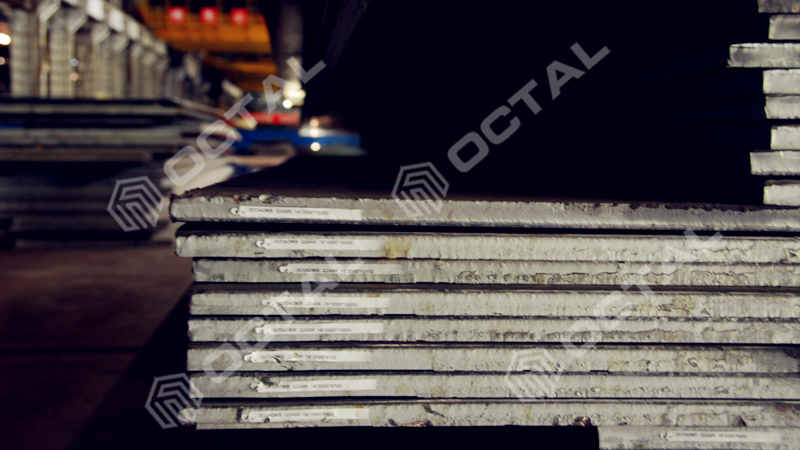
Referenced Documents
ASTM Standards:
- A20/A20M: Specification for General Requirements for Pressure Vessel Plates
- A435/A435: For Straight-Beam Ultrasonic Examination of Steel Plate
- A577/A577M: For Ultrasonic Angle-Beam Examination of Steel Plates
- A578/A578M: For Straight-Beam Ultrasonic Examination of Rolled Steel Plates for Special Applications
Manufacturing Notes:
Steel Plate under ASTM A537 Class 1, 2 and 3 shall be killed steel and comply with fine austenitic grain size requirement of Specification A20/A20M.
Heat Treatment Methods
All plates under ASTM A537 shall be heat treated as follows:
ASTM A537 Class 1 plates shall be normalized.
Class 2 and Class 3 plates shall be quenched and tempered. The tempering temperature for Class 2 plates shall not be less than 1100°F [595°C] and not less than 1150°F [620°C] for Class 3 plates.
Chemical Requirements of ASTM A537 Class 1, 2 and 3
The steel shall conform to the chemical requirements shown in Table 1 unless otherwise modified in accordance with Supplementary Requirement S17, Vacuum Carbon-Deoxidized STeel, in Specification A20/A20M.
Table 1:
Element | Heat Analysis | Product Analysis |
|---|---|---|
Carbon, max A | 0.24 | |
Manganese (Tk≤40 mm or 1-1/2 in) | 0.70-1.35 | 0.64-1.46 |
Manganese B | 1.00-1.60 | 0.92-1.72 |
Phosphorus, max A | 0.025 | |
Sulfur, max A | 0.025 | |
Silicon | 0.15-0.50 | 0.13-0.55 |
Copper, max | 0.35 | 0.38 |
Nickel, max | 0.25 | 0.28 |
Chromium, max | 0.25 | 0.29 |
Molybdenum, max | 0.08 | 0.09 |
A: Applies to both heat and product analysis.
B: Manganese may exceed 1.35% on heat analysis, up to a maximum of 1.60%, and nickel may exceed 0.25% on heat analysis, up to a maximum of 0.50%, provided the heat analysis carbon equivalent dose not exceed 0.57^ when based upon the following equation:
CE = C + Mn/5 + (Cr+Mo+V)/5 + (Ni+Cu)/15
When this option is exercised, the manganese and nickel contents on product analysis shall not exceed the heat analysis content by more than 0.12% and 0.03%, respectively.
Mechanical Requirements for A537 CL1, CL2, CL3
Tensile strength and yield strenght: The material as represented by the tension-test specimens shall conform to the requirements shown in Table 2.
For Class 2 and Class 3 plates with a nominal thickness of 3/4 in. [20 mm] and under, the 1 1/2-in. [40 mm] wide rectangular specimen may be used for the tension test, and the elongation may be determined in a 2-in. [50 mm] gage length that includes the fracture and that shows the greatest elongation.
Mechanical Properties inch and [mm] | Class 1 | Class 2 | Class 3 |
|---|---|---|---|
ksi [MPa] | ksi [MPa] | ksi [MPa] | |
Tensile Strength | |||
2-1/2 in. and under | 70-90 | 80-100 | 80-100 |
[65 mm and under] | [485-620] | [550-690] | [550-690] |
Over 2-1/2 to 4 in | 65-85 | 75-95 | 75-95 |
[Over 65 to 100mm] | [450-585] | [515-655] | [515-655] |
Over 4 to 6 in | A | 70-90 | 70-90 |
[Over 100 to 150 mm] | A | [485-620] | [485-620] |
Yield strength, min: | |||
2-1/2 in. and under | 50 | 60 | 55 |
[65 mm and under] | [345] | [415] | [380] |
Over 2-1/2 to 4 in | 45 | 55 | 50 |
[Over 65 to 100 mm] | [310] | [380] | [345] |
Over 4 in to 6 in | A | 46 | 40 |
[Over 100 to 150 mm] | A | [315] | [275] |
Elongation in 2 in | |||
[50 mm], min, %B | 22 | 22 | 22 |
4 in, [100 mm] and under | A | 20 | 20 |
Over 4 in [100 mm] | |||
Elongation in 8 in | |||
[200 mm], min, %B | 18 | C | C |
A: Product is not availabe in this size range.
B: See specification A20/A20M for elongation adjustments.
C: There is no requirement for elgonation in 8 in.
Our Supply Range:
Description: Carbon Steel ASTM A537 Class 1, 2, 3
Manufacturing Types: Hot Rolled
Thickness: 2mm to 150 mm
Width: 0.6m to 3m
Length: 6m, 12m, customized
Surface: Natural, Painted
Packing: Standard sea packing, bundled with streel strip.
FAQ
Q1: What is the difference between ASTM A537 Class 1 and Class 2?
A1: Class 1 is normalized, while Class 2 is quenched and tempered. For plates 65 mm [2.5 in.] and under, the minimum yield strength is 345 MPa for Class 1 and 415 MPa for Class 2, so class selection must account for both heat-treatment condition and required design strength.
Q2: Does ASTM A537 have a fixed maximum plate thickness?
A2: No. Under current ASTM A537/A537M-20, maximum plate thickness is limited by the material's ability to meet the specified mechanical-property requirements rather than by one fixed thickness value.
Q3: Are Charpy impact testing and ultrasonic testing mandatory for ASTM A537 plate?
A3: Not automatically for every order. Additional testing or examination requirements governed through ASTM A20 supplementary requirements apply when specified by the purchaser, so the required impact-test conditions, UT standard and acceptance criteria should be defined in the purchase order or project specification.
Q4: Can ASTM A537 Class 2 replace ASTM A516 Grade 70?
A4: Not automatically. A537 Class 2 is a quenched-and-tempered carbon-manganese-silicon plate, while A516 Grade 70 is a carbon steel pressure-vessel grade for moderate- and lower-temperature service. Any substitution must satisfy the vessel design code, required mechanical properties, toughness requirements and project material specification.
Featured Products:
ASTM A283 Grade C, D Plates
ASTM A516 Grade 70, 65, 60 Steel Plate
ASTM A515 Grade 60, 65, 70 Plate
ASTM A537 Class 1, 2 Plates
ASTM A572 Grade 50, 60 Steel Plates
AH36, DH36, EH36 Shipbuiding Steel Plates
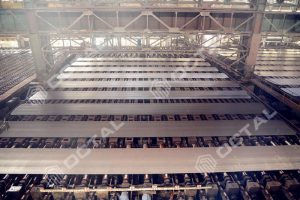
Carbon Steel Plate